
- DR-Singh-Harjinder-DDS-Admin
- 15 Feb, 2026
- 0 Comments
- 5 Mins Read
Understanding PRF in Post-Surgical Healing
PRF & Wisdom-Tooth Healing
Understanding PRF in Post-Surgical Healing
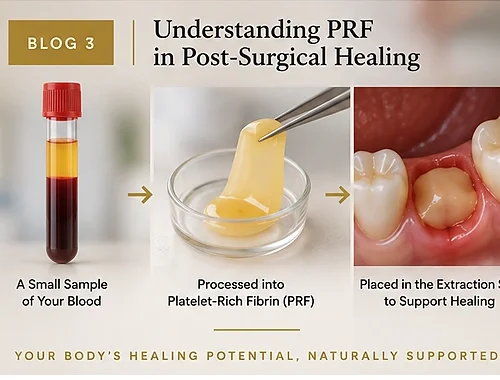
If you are preparing to have lower wisdom teeth removed, you may hear the term PRF as part of the treatment discussion. PRF stands for platelet-rich fibrin, a material prepared from the patient’s own blood and placed into a surgical site with the goal of supporting the body’s normal healing process.
What current evidence suggests:
PRF may offer useful benefits after lower wisdom-tooth surgery, particularly for dry socket and some early postoperative discomfort. It should not be presented as a guarantee of faster healing, no pain, no swelling or a complication-free recovery.
What Is Platelet-Rich Fibrin?
Platelet-rich fibrin is an autologous material, meaning it comes from the patient’s own blood.
In general, a small blood sample is collected and processed so that a fibrin-rich material containing platelets and other blood components can be separated. That material can then be placed into an extraction socket during dental surgery.
What PRF Is
A fibrin-rich material derived from the patient’s own blood and used as a surgical healing adjunct.
What PRF Is Not
It is not a medication, an artificial implant or a substitute for normal postoperative care and professional follow-up.
The fibrin provides a natural matrix, while platelets and associated biological factors are involved in normal wound-healing processes.
Different PRF preparations and processing methods exist, which is one reason research results do not always agree perfectly from one study to another.
Why Is PRF Discussed With Lower Wisdom Teeth?
Removing a lower wisdom tooth can involve more tissue and bone than a straightforward extraction, particularly when the tooth is impacted.
Common short-term effects after mandibular wisdom-tooth surgery can include pain, swelling and temporary difficulty opening the mouth. Another possible complication is alveolar osteitis, commonly called dry socket.
Researchers have studied whether placing PRF into the extraction socket can improve some of these postoperative outcomes.
What Does the Latest Evidence Say?
2026 Systematic Review & Meta-Analysis
Possible Benefit for Early Symptoms and Dry Socket
A 2026 systematic review and meta-analysis examining 28 randomized controlled trials found that PRF was associated with less pain on several postoperative days, less swelling during certain early measurements and a lower occurrence of alveolar osteitis.
The researchers did not find a significant improvement in soft-tissue or bone healing, and the certainty of evidence differed between outcomes.
2024 Systematic Review & Meta-Analysis
Encouraging Results, With Some Uncertainty
A 2024 systematic review and meta-analysis similarly reported potential reductions in postoperative pain, swelling, dry socket and limited mouth opening following lower third-molar extraction. The authors found uncertainty around some healing outcomes.
2026 Umbrella Review
The Evidence Base Still Has Limitations
An August 2026 umbrella review examined 19 systematic reviews and meta-analyses. It found relatively consistent evidence that PRF can reduce alveolar osteitis and postoperative pain after mandibular third-molar extraction.
At the same time, the reviewers found substantial limitations in the methodological quality of the existing review literature: only two of the 19 reviews reached high or moderate confidence under their strict assessment.
The practical takeaway
PRF appears to be a promising adjunct after lower wisdom-tooth removal, particularly for reducing dry-socket risk and some early postoperative symptoms, but it should not be presented as a guarantee of an easier or complication-free recovery.
Does PRF Prevent Dry Socket?
No treatment can honestly be described as guaranteeing that dry socket will not occur.
Current research does suggest that PRF may reduce the risk. A recent meta-analysis focused specifically on alveolar osteitis found a lower incidence among extraction sites treated with PRF compared with controls.
“Lower risk” and “cannot happen” are very different claims.
Individual risk can be affected by the procedure, the extraction site, patient factors and postoperative behavior.
PRF also does not replace the instructions given after surgery. Patients still need to protect the extraction sites and follow their dentist’s directions regarding eating, oral hygiene, activity, smoking or vaping, medications and other aspects of recovery.
How Dr. Singh Uses PRF for Lower Wisdom Teeth
At Dr. Harjinder Singh’s Yuba City practice, PRF is a confirmed part of the current approach to lower wisdom-tooth treatment.
Current practice policy
PRF is used for all lower wisdom teeth treated under the practice’s current policy.
Outside that specific lower-wisdom-tooth policy, PRF and related adjuncts may be used selectively rather than automatically with every extraction.
Dr. Singh has reported that he uses PRF with the intention of supporting healing and reducing problems such as dry socket, and he has observed favorable recovery experiences in his own patients.
Those observations represent his clinical experience; they should not be confused with proof that every patient will have the same result.
This is also a practice-specific policy, not a statement that PRF is mandatory for every wisdom-tooth procedure performed by every dentist.
PRF Does Not Replace Good Aftercare
PRF is placed during treatment. Recovery continues afterward.
Even when PRF is used, patients can still experience pain, swelling, bleeding and other normal postoperative effects. Complications are still possible, and patients should not change their aftercare because they assume PRF has eliminated those risks.
PRF May Support Healing
Current research suggests possible benefits for certain postoperative outcomes.
Aftercare Still Matters
Clot protection, postoperative instructions, prescribed medication directions and professional follow-up remain important.
Questions to Ask Before Wisdom-Tooth Treatment
If PRF is included in your proposed treatment, useful questions are simple:
- Why is PRF being used in my case?
- What benefits are reasonably expected?
- What can PRF not guarantee?
- Is there a separate charge?
- What postoperative instructions still apply?
Those questions help separate evidence-based expectations from marketing claims. They are especially important because research continues to evolve and because PRF preparation and clinical protocols are not identical across every dental practice or study.
PRF Is Only One Part of the Wisdom-Tooth Decision
The more important questions are whether a wisdom tooth needs treatment, its position and anatomy, whether additional imaging is appropriate, what anesthesia or sedation options apply, and what risks and alternatives should be considered.
For lower wisdom teeth treated at Dr. Singh’s Yuba City office, PRF is incorporated into the practice’s current treatment approach. It may offer meaningful postoperative benefits according to current research, but individual recovery can never be guaranteed.