
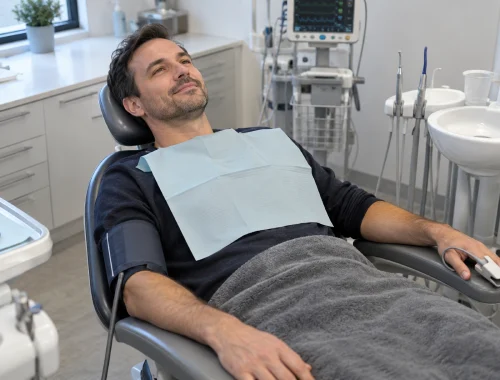
Dental treatment can feel more manageable when the comfort plan fits you.
If fear, a previous difficult experience, or the thought of an extraction, wisdom-tooth procedure or implant treatment is making you hesitate, Dr. Harjinder Singh offers several comfort and sedation options for appropriate patients.
The right choice is not simply “more sedation.” It starts with understanding what you are worried about, how you have responded to dental treatment before, what procedure is planned, and what your health history allows.
Numbing and sedation do two different jobs.
Patients often say, “I don’t want to feel anything,” when they are really worried about two separate things: pain during treatment and anxiety about the experience. Those concerns are related, but they are not identical.
Local anesthesia is for numbing.
Local anesthetic is used to block sensation in the area being treated. It is the usual anesthesia approach for dental procedures in this practice unless an additional sedation method is selected.
Even when you receive oral or IV sedation, local anesthesia may still be needed for the dental procedure itself.
Sedation is for anxiety and awareness.
Sedation is used to help appropriate patients feel calmer and less focused on treatment. Different methods produce different levels of relaxation and responsiveness.
Moderate conscious sedation can make you drowsy and deeply relaxed, but it should not be described as the same thing as being under general anesthesia.
The sedation method should match the patient, not just the procedure.
Dr. Singh provides nitrous oxide, oral sedation, and IV moderate conscious sedation. Each option has a different role, and the most appropriate choice depends on your anxiety, procedure, health history, medications, previous experiences and practical arrangements for the day.
A lighter option for reducing dental anxiety
Nitrous oxide, commonly called laughing gas, is inhaled through a small nosepiece during treatment. You remain conscious and able to respond. For some patients, this is enough to make a procedure feel less stressful without moving to oral or IV sedation.
It may be considered when the main concern is nervousness or apprehension and the patient’s overall situation makes it appropriate.
Medication taken by mouth for a deeper level of relaxation
Oral sedation may be considered when a patient needs more help with anxiety than nitrous alone may provide. Because medication response varies from person to person, the plan has to account for your health history, other medications and the treatment being performed.
Your individual pre-appointment instructions matter. Do not change a prescribed medication, food or drink routine based only on general website information.
Moderate conscious sedation administered through an IV
IV sedation allows sedative medication to be administered intravenously for appropriate patients. The goal is a moderate level of sedation in which you may feel very relaxed and drowsy while still remaining purposefully responsive.
This is an important distinction from general anesthesia. Some patients may remember little about parts of the appointment, but complete unconsciousness or guaranteed amnesia should not be expected or promised.
Fear is not a reason to avoid necessary dental treatment without first discussing your options.
Some patients need only reassurance and careful local anesthesia. Others may benefit from an additional sedation method. The useful question is not whether you are “brave enough” for treatment; it is what combination of comfort, anesthesia and clinical planning is appropriate for your situation.
Severe dental anxiety or a strong fear of treatment
A previous dental experience that makes another procedure difficult to face
Anxiety about wisdom-tooth removal, extractions or implant treatment
A referred case in which additional sedation support has been requested
Difficulty completing necessary treatment while fully alert
A need to understand whether a stronger comfort option is medically appropriate
Sedation can help anxiety, but it does not replace proper local anesthesia.
A person can be very anxious even when local anesthetic works normally. Another patient may stay calm but have a history of taking longer to become numb or needing a technique adjusted.
Dr. Singh describes his approach to difficult-to-anesthetize patients as technique-sensitive, experience-based and willing to allow adequate time for local anesthesia to take effect. Other dentists also refer some patients to the practice because they have been difficult to anesthetize in the past.
A sedation plan starts with the whole patient.
Dr. Singh does not need every anxious patient to receive the same level of sedation. The plan is based on the treatment being considered and the information that affects whether office-based sedation is appropriate.
Your procedure
The type of dental treatment, expected complexity and length of the appointment can affect which comfort options are worth discussing.
Your level of anxiety
Being mildly nervous is different from severe dental phobia or a history of being unable to complete treatment because of fear.
Your health history
Medical conditions, previous anesthesia or sedation experiences, allergies and recent health changes can all affect the plan.
Your medications
Prescription medicines, non-prescription products and other relevant substances should be disclosed so the office can give instructions that fit your situation.
Your ability to follow preparation and recovery instructions
Fasting directions when specifically given, medication instructions, transportation and responsible-adult arrangements can be important parts of safe planning.
Follow the instructions written for your sedation plan—not a generic checklist from the internet.
Preparation can differ by sedation method and by patient. The office may need to review your medical history, medications and previous reactions, and medical clearance may be requested when appropriate.
Information to share
Current medical conditions and recent changes in your health
Prescription and non-prescription medications
Known allergies or previous medication reactions
Previous problems with anesthesia or sedation
Pregnancy or possible pregnancy when relevant
Any physician or specialist involvement the office asks about
Instructions may include
When to stop eating or drinking, if fasting is required for your plan
What to do with your normal medications that day
Who must bring you to the office and drive you home
Whether a responsible adult should remain with you afterward
What to do if you become ill or your health changes before treatment
Any procedure-specific preparation given by the practice
A calm appointment still begins with safety checks.
Confirm the plan
The team reviews relevant health or medication changes and confirms that required preparation instructions were followed.
Provide the selected comfort method
Nitrous, oral medication or IV moderate sedation is used according to the plan made for that patient.
Numb the treatment area
Local anesthesia is used as appropriate for the dental procedure, even when an additional sedation method is part of the visit.
Monitor and complete treatment
The procedure is completed with monitoring and observation appropriate to the sedation method and clinical situation.
Recover before leaving
Patients receiving sedation that affects alertness are assessed during recovery and leave according to the office’s discharge and transportation instructions.
Feeling “fine” is not the same as being ready to drive.
Recovery is different for nitrous, oral sedation and IV moderate sedation. The office will tell you what transportation, supervision, food, medication and activity restrictions apply to your specific plan.
If a responsible adult driver or escort is required, arrange that before the appointment. Do not plan to drive simply because you feel alert afterward.
Follow the written instructions you receive and contact the practice if a recovery concern falls outside what you were told to expect.
Not every patient or medical situation belongs in office-based sedation.
Sedation is part of a procedure-focused practice, not an add-on to routine dentistry.
Harjinder Singh, DDS focuses his practice on procedures such as tooth extractions, wisdom teeth and dental implants. The practice also receives professional referrals for patients who need sedation and for some patients who have been difficult to anesthetize.
Client-confirmed experience focused on extraction and implant work.
Nitrous oxide, oral sedation and IV/moderate conscious sedation are available for appropriate patients.
Dr. Singh personally administers the practice’s moderate conscious sedation for appropriate patients.
Start with the treatment you actually need.
This page explains the comfort and sedation choices. The treatment pages explain the procedure itself.
Tell us what makes dental treatment difficult for you.
When you contact the office, mention severe anxiety, a previous bad dental experience, past difficulty becoming numb, previous sedation problems, or a specific request to discuss IV sedation. That information helps start the right conversation before treatment is scheduled.
Harjinder Singh DDS, Inc.
1675 Butte House Rd, Yuba City, CA 95993
Posted on Google
 Marisela Villegas
Trustindex verifies that the original source of the review is Google.
Was amazing no pain at all I honestly recommend themPosted on Google Alejandra Villa PinedaEXCELENTE!
Owner's reply
Thanks for the review and the feedback.Posted on Google Steve Pemberton
Owner's reply
Thanks for the review and the feedback.Posted on Google Sarah ReinhardtI went with my 90 year old mother for an almost full mouth extraction with Dr. Singh and we were SO pleased with not only how skilled he was, but how kind he was. He was so gentle and she has recovered amazingly well! Thank you so much Dr. Singh and your kind office staff!!
Owner's reply
Thanks for giving us the opportunity to help your Mom and the review.Posted on Google Hameda DaqiqI am very happy with this clinic. The staff treated me so kindly and professionally, and their care for patients was excellent. I had four teeth extracted in one day, and I didn’t feel any pain at all. Everything was comfortable and went very smoothly. I was really impressed with their work and the way they treated me. I highly recommend this clinic!
Owner's reply
Thanks for the review and the feedback.Posted on Google Uqsam KhanDr. Singh was extremely kind and informative of the wisdom tooth extraction process. It was quick and painless. Highly recommend!
Owner's reply
Thanks for the review and the feedback.Posted on Google Nicola Weir
Owner's reply
Thanks for the review and the feedback.Posted on Google Harrison Branum lllThey do professional work. I recommend these people to everyone...
Owner's reply
Thanks for the review and the feedback.Posted on Google Ed LucasGreat sense of humor, listens,
Owner's reply
Thanks for the review and the feedback.Posted on Google Christopher DavenportWent in to have 3 teeth extracted, I was extremely nervous going in but Dr.Singh was very reassuring and nice. Had the 3 teeth removed before I even knew it and I didn’t feel a thing. By far the best experience I’ve ever had in any kind of Dr office.
Owner's reply
Thanks for the feedback.Load moreVerified by TrustindexTrustindex verified badge is the Universal Symbol of Trust. Only the greatest companies can get the verified badge who has a review score above 4.5, based on customer reviews over the past 12 months. Read more