
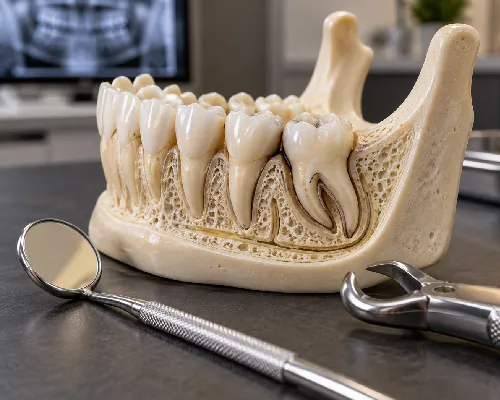
Patient Resource · Treatment Decision
Root Canal vs Tooth Extraction
These treatments do not compete to do the same job. A root canal is used to help preserve a tooth that can reasonably be restored. An extraction removes the tooth when keeping it is not appropriate, not possible, or not the chosen treatment path.
The most useful question is not simply “Which procedure is better?” It is “Can this particular tooth be predictably saved and restored, and what are the consequences of each path?”
Two treatments. Two different goals.
Root canal treatment
Preserve the natural tooth
Endodontic treatment removes diseased or infected pulp from inside the tooth, cleans and seals the internal space, and is followed by an appropriate restoration so the tooth can remain in function when its overall prognosis is reasonable.
Tooth extraction
Remove the tooth
Extraction removes the tooth from its socket. That may be appropriate when the tooth is not reasonably restorable, has an unfavorable prognosis, or removal is otherwise the selected treatment after the relevant options have been considered.
The American Association of Endodontists describes root canal treatment as a tooth-preserving option and encourages patients to understand whether a natural tooth can be retained before choosing extraction. Read the AAE patient resource.
The decision before the decision
Can the tooth be reasonably restored?
A tooth can have an infected or damaged pulp and still be worth saving. In other situations, damage to the tooth itself or the tissues supporting it may make a predictable restoration difficult or unrealistic. That is why “I need a root canal” and “this tooth can be successfully restored” are not always the same statement.
01
Remaining tooth structure
There must be enough sound tooth structure—or a realistic restorative plan—to support the tooth after endodontic treatment. Extensive decay or loss of tooth structure can change the prognosis.
02
Cracks and fractures
Not every crack means extraction, but the location, direction and extent of a fracture matter. Some fractures can make a tooth non-restorable even if the nerve inside the tooth could technically be treated.
03
Bone and periodontal support
A tooth also depends on the gums, bone and periodontal attachment around it. Endodontic treatment does not correct every problem affecting the tissues that support the tooth.
04
Infection, prior treatment and prognosis
The extent of infection, previous root-canal treatment, previous restorations, anatomy and whether retreatment or another tooth-saving procedure is reasonable can all influence the recommendation.
05
The whole restorative plan
A useful decision considers what happens after the root canal or after the extraction—not only the first procedure. Bite, neighboring teeth, replacement needs, long-term maintenance and the patient’s priorities can all matter.
That requires a clinical examination and appropriate imaging, and sometimes input from a dentist with expertise in endodontic and restorative treatment.
What each path actually involves
Compare the complete treatment path—not one appointment in isolation
Attempt to keep the tooth
- Assess restorability and endodontic prognosis. Determine whether preserving the tooth is a reasonable goal.
- Root canal treatment when indicated. Diseased pulp is removed and the internal root-canal space is cleaned, disinfected, filled and sealed.
- Restore and protect the tooth. A filling, crown or other restoration may be needed depending on the tooth and remaining structure.
- Maintain and monitor it. A root-treated tooth still needs normal dental care and can develop future problems.
Remove the tooth
- Confirm why extraction is being considered. Examples can include non-restorability, unfavorable fracture or prognosis, failed treatment that cannot reasonably be corrected, or another clinical reason.
- Extract the tooth. The tooth is removed from the socket using the approach appropriate for that case.
- Plan the socket and healing. Depending on future goals, socket preservation or other site management may be discussed.
- Decide what happens to the space. Some spaces may be left as they are; others may be replaced with an implant, bridge or removable option depending on the situation.
Why the page stays balanced: systematic reviews have found both endodontically treated teeth and implant-supported replacement to be viable options in appropriately selected cases. The choice is not a universal contest between “root canal” and “implant”; it starts with the prognosis of the actual tooth and the complete treatment plan.
View the systematic review on PubMedSimplified educational illustration—not a diagnostic image. A real restorability decision depends on clinical findings and appropriate imaging.
Why “the nerve is infected” is not the whole story
The inside of the tooth can be treated only if the tooth around it can still serve a useful purpose
Root canal treatment addresses disease inside the tooth. The final prognosis also depends on whether the tooth can be restored and supported afterward.
That distinction is especially important when a tooth has extensive decay, a deep crack, major structural loss, periodontal problems or previous treatment. A patient may need both an endodontic opinion and a restorative opinion before an irreversible decision is made.
Previously treated tooth
A problem after a root canal does not automatically mean the tooth must be extracted
Some root-treated teeth develop persistent or new disease, fracture, recurrent decay, restorative failure or other problems. Depending on the cause and the tooth’s condition, options can include endodontic retreatment, endodontic surgery, restorative treatment—or extraction when the tooth cannot reasonably be retained.
If tooth-saving treatment still appears plausible, an endodontic evaluation may be appropriate before removal. If the tooth is non-restorable or extraction has already been recommended after appropriate evaluation, Dr. Singh can assess the extraction side of the plan.
See AAE guidance on treatment options for a diseased toothIf the tooth is removed
Extraction can solve the tooth problem—but it may create a separate space-and-replacement decision
Whether a missing tooth should be replaced depends on which tooth is missing, the bite, neighboring teeth, bone, appearance, function, health and the patient’s priorities. Replacement is not automatically the same for everyone.
Remove the problem tooth
When extraction is appropriate, the immediate goal is to remove the tooth safely and manage the surgical site.
Consider the future site
If implant replacement may be considered later, bone and socket management can become part of the discussion. Not every extraction site requires the same approach.
Choose whether and how to replace it
Depending on the case, possibilities may include no replacement, a dental implant, a bridge or a removable prosthetic option. The appropriate choice belongs in a restorative treatment plan.
Already discussing implant replacement?
Read about Dental Implants Read about Bone Grafting & Socket Preservation“Which one is cheaper or faster?”
Compare the complete plan, not just the first procedure
A root canal can involve endodontic treatment plus the restoration needed to protect the tooth. An extraction may involve only removal—or it may be followed by grafting, an implant, a bridge, or another replacement plan.
Because the number of visits, treatment sequence, insurance benefits and future restorative needs vary, a universal “root canal is cheaper” or “extraction is faster” statement can be misleading. Ask for the expected complete pathway for your actual tooth.
Insurance & Financing information belongs on the practice’s dedicated access page rather than being repeated here.
Important practice boundary
Dr. Singh provides extraction care—not routine root-canal treatment
Harjinder Singh, DDS, leads a procedure-focused practice in Yuba City. Routine root-canal therapy is not part of the practice’s normal service model.
If the tooth may still be restorable
Discuss tooth-saving treatment with your general dentist and, when appropriate, an endodontic provider. If you are told extraction is the only option but do not understand why, it is reasonable to ask what makes the tooth non-restorable or whether another tooth-saving evaluation is appropriate.
If extraction is already recommended
Dr. Singh can evaluate the extraction, discuss surgical considerations for the actual tooth, and explain relevant next steps. If future implant replacement is being considered, that can be planned separately.
Learn about Tooth ExtractionsBefore an irreversible decision
Ask three things:
- 01Is the tooth reasonably restorable?
- 02What is its expected prognosis if treated?
- 03If it is removed, what is the plan for the space?
Useful conversation to have
A recommendation is more useful when you understand the reason behind it
“This tooth needs to come out” should ideally come with an explanation of what limits the tooth-saving options. Likewise, “we can try a root canal” should include a realistic discussion of whether the tooth can be restored afterward.
The decision becomes clearer when the diagnosis, restorability and downstream plan are discussed together.
Questions worth asking before you decide
Bring the conversation back to your tooth—not a generic pros-and-cons list
- What specifically makes this tooth restorable or non-restorable?
- Is there a crack or fracture, and where does it extend?
- How much healthy tooth structure remains for a final restoration?
- What is the condition of the bone and periodontal support around the tooth?
- If I attempt root-canal treatment, what restoration is expected afterward?
- If this tooth has already had a root canal, is retreatment or endodontic surgery worth evaluating?
- If the tooth is extracted, does the space need to be replaced?
- If I might want an implant later, should socket preservation be discussed now?
- What are the main uncertainties or limitations with either path in my case?
Next step
Choose the evaluation that matches the decision you still need to make
Still deciding whether the tooth can be saved?
Start with the dentist responsible for diagnosing and restoring the tooth, and ask whether endodontic evaluation is appropriate before extraction.
Extraction has been recommended?
Request an evaluation with Dr. Singh to discuss the extraction itself and any relevant surgical or future replacement considerations.
1675 Butte House Road, Yuba City, CA 95993
Authoritative patient reading
Sources used for the general educational framework
Practice-specific statements on this page come from the project’s confirmed practice information. The clinical background is supported by independent endodontic and peer-reviewed sources.
- American Association of Endodontists — Root Canal vs Extraction
- American Association of Endodontists — Treatment Options for the Diseased Tooth
- Systematic review — endodontic therapy vs extraction and implant-assisted replacement
- Systematic review — endodontically treated teeth vs implant-supported prostheses