
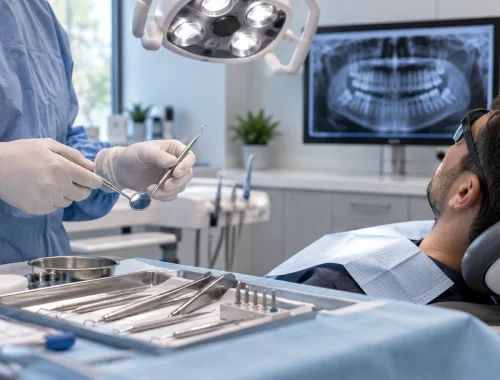
Focused procedural dentistry in Yuba City
Additional Surgical Dental Procedures
If another dentist or orthodontist gave you the name of a less common procedure, this page helps you confirm whether Dr. Harjinder Singh, DDS provides it, understand the basic purpose, and see where his part of treatment begins and ends.
Dr. Singh is a general dentist whose practice is focused on oral-surgery-related dental procedures, dental implants, extractions and selected related treatment. This page covers confirmed secondary procedures without presenting the practice as a broad multispecialty center.
Start with the name you were given
You do not need to know every technical detail before contacting the office. If a dentist, orthodontist or other clinician recommended a procedure, tell us the exact name if you have it. A referral is not universally required, although professional coordination is especially useful for procedures such as impacted-canine exposure and treatment related to an existing root canal or restoration.
If you already have recent dental X-rays, a referral note or treatment records, bring or send them when arranging your visit. Existing records may be useful, but Dr. Singh may still need current imaging or an examination before deciding whether the proposed procedure is appropriate.
Not sure what the procedure is called? Describe what your dentist told you, the tooth or area involved, and what treatment is planned next. The office can help determine the right appointment type.
What kind of problem is being addressed?
These procedures are easier to understand when grouped by the structure or treatment decision involved. The groups below are for navigation—not a diagnosis.
Jawbone: alveoloplasty and tori removal
Gum & frenum: depigmentation, frenectomy, tongue-tie and crown lengthening
Tooth & diagnosis: apicoectomy and oral biopsy
Coordinated / adjunctive care: impacted canine exposure, PRP and myofascial-pain botulinum toxin treatment
Jawbone and pre-prosthetic procedures
These procedures reshape or remove bone when the contour itself is part of the problem.
Alveolectomy / alveoloplasty
Jawbone smoothing or reshaping around tooth sockets
Alveoloplasty generally refers to smoothing or recontouring the bony ridge that holds the teeth. Alveolectomy is a related term involving removal of alveolar bone. In everyday patient conversations, the terms can overlap, so the important question is what bone contour needs to change and why.
It may be discussed at the time of an extraction or after healing when a ridge is sharp, uneven or needs reshaping for another dental plan. It is not the same as bone grafting: alveoloplasty reshapes existing bone, while grafting adds or rebuilds bone for a different purpose.
Tori removal
Removal of bony growths when treatment is actually needed
Dental tori are benign bony growths that can occur along the lower jaw (mandibular tori) or the roof of the mouth (palatal tori). Many tori do not need treatment at all. Removal may be discussed when a growth repeatedly becomes irritated, interferes with oral function, or prevents a dental appliance from fitting properly.
A lump or hard area in the mouth should be examined rather than self-diagnosed as a torus. The reason for removing a confirmed torus matters more than the size alone.
Gum, frenum and soft-tissue procedures
These treatments involve gum contours or a frenum—the small band of tissue that connects parts of the lips or tongue to nearby tissue.
Gum depigmentation
Also searched as gingival depigmentation, gum bleaching or gum lightening
Gum depigmentation is intended to reduce visible dark pigmentation in gingival tissue when treatment is appropriate. There are several accepted techniques in dentistry, and pigmentation can return over time in some patients.
Because not every dark area has the same cause, the first step is confirming that the pigmentation is suitable for elective depigmentation rather than assuming every color change should be treated.
Frenectomy
Treatment of a frenum when its attachment is contributing to a functional or dental concern
A frenectomy removes or releases frenum tissue. Depending on which frenum is involved, the treatment discussion may relate to tongue movement, lip attachment, orthodontic planning, gum tension or another dental concern.
A frenectomy is not automatically necessary just because a frenum looks prominent. The reason for treatment should be based on function, dental findings and the broader treatment plan.
Tongue-tie treatment
Evaluation of a restrictive lingual frenum (ankyloglossia)
Tongue-tie describes restriction related to the lingual frenum under the tongue. Appearance alone does not determine whether treatment is needed; function and the reason for the evaluation matter.
This practice offers tongue-tie treatment, but this page does not position the office as an infant feeding, pediatric dentistry, lactation or speech-therapy program. Patients or parents should contact the office to confirm age eligibility and whether Dr. Singh’s service fits the specific concern.
Crown lengthening
Exposing more natural tooth by changing the gum level and, when needed, supporting bone
Crown lengthening can be used in dentistry when more tooth structure needs to be exposed for a restoration or, in some situations, to change the appearance of the gum-to-tooth relationship. The procedure may involve gum tissue and sometimes bone around the tooth.
If another dentist is planning a crown or restoration, coordination matters because the surgical step and the final restorative step may be completed by different clinicians.
Tooth-preserving and diagnostic surgery
These procedures answer two very different questions: can a previously treated tooth be managed surgically, and what is an unexplained area of oral tissue?
Apicoectomy / root-end surgery
Surgery at the root tip of a tooth that has usually already had root-canal treatment
An apicoectomy is root-end surgery. It may be considered when inflammation or infection persists around the end of a root after previous root-canal treatment, or when a problem cannot be resolved through the usual nonsurgical route.
The important distinction is that an apicoectomy is not routine root-canal therapy. Whether a tooth is better managed with endodontic retreatment, root-end surgery or extraction depends on the tooth, prior treatment and diagnostic findings.
Trying to understand the broader decision? Read the Root Canal vs Tooth Extraction guide.
Oral biopsy / oral pathology biopsy
A tissue sample sent to an outside laboratory for microscopic examination
An oral biopsy removes a small amount of tissue from an area that needs a more definite explanation. Biopsy may be used for a persistent or unusual lump, sore, patch or other tissue change when examination alone cannot establish what it is.
Being referred for a biopsy does not mean that cancer has already been diagnosed. The purpose is to obtain tissue that a pathology laboratory can examine under a microscope so the next decision is based on a diagnosis rather than appearance alone.
Biopsy at the practice
Dr. Singh obtains the tissue specimen.
Outside pathology laboratory
The specimen is examined and a report is prepared.
Report returns to the office
The practice receives the histopathology report.
Result shared with you
Next steps depend on what the report shows.
When surgery is only one part of a larger treatment plan
Some procedures are most useful when everyone is clear about who is responsible for each phase. Impacted-canine exposure is the clearest example on this page.
Impacted canine exposure / attachment / chain-and-bonding
An impacted canine is a permanent canine tooth that has not erupted into its expected position. When an orthodontist plans to move an impacted canine into the dental arch, a surgical exposure may be needed so an attachment can be bonded to the tooth.
Whether exposure and orthodontic traction are appropriate depends on the tooth’s position and the orthodontic treatment plan. Surgical exposure is not a substitute for orthodontic treatment, and movement of the tooth is not guaranteed simply because it has been exposed.
Orthodontic plan
The treating orthodontist determines whether surgical exposure is part of the plan.
Surgical phase with Dr. Singh
The tooth is exposed and an attachment is bonded as planned.
Back to the orthodontist
Orthodontic movement and ongoing alignment continue with the treating orthodontic team.
For dentists and orthodontists: the office accepts professional referrals for appropriate procedural care and can limit treatment to the referred surgical phase. Visit Referring Dentists for records and coordination information.
Adjunctive treatments that need careful case selection
These services should not be presented as universal add-ons or guaranteed solutions.
PRP (platelet-rich plasma)
A blood-derived concentrate used as an adjunct in selected dental and oral-surgical settings
Platelet-rich plasma is prepared from a patient’s own blood and contains a concentrated level of platelets. Research has evaluated PRP in several oral-surgery and regenerative settings, but results vary by procedure and by how PRP is used.
That is why PRP should not be described as automatically necessary or as a guarantee of faster healing or better bone growth. The relevant question is whether it adds value to the specific treatment plan being considered.
Botox / botulinum toxin for myofascial pain
A narrowly defined pain-related service—not a cosmetic Botox page
Myofascial pain involves painful muscle and surrounding soft-tissue trigger areas. Botulinum toxin has been studied for muscular temporomandibular and myofascial pain, particularly when symptoms persist despite conservative care, but the evidence is not a reason to treat every person with jaw pain the same way.
Botulinum toxin treatment for dental or masticatory myofascial pain is an off-label use rather than an FDA-approved BOTOX indication. A clinician must weigh diagnosis, alternatives, expected benefit and possible adverse effects for the individual patient.
What about cost, insurance, comfort and recovery?
Those questions are reasonable, but one generic answer would be misleading across eleven very different procedures. The cost and insurance handling depend on the named procedure and your benefits. Recovery and comfort needs also differ based on the site, extent of treatment, health history and other care being performed.
The office can explain the financial and scheduling details that apply after your procedure is identified. For broader coverage and payment information, see Insurance & Financing. If sedation may be relevant to your procedure, the detailed options belong on the Sedation Dentistry page rather than being repeated here.
After any procedure, follow the instructions Dr. Singh gives for your actual treatment rather than relying on a recovery timeline from a different procedure or another patient’s experience.
Not sure whether your procedure fits this page?
Tell the office what you were referred for.
Contact Harjinder Singh DDS, Inc. with the procedure name, the area involved and any referral or X-rays you already have. The team can help determine whether Dr. Singh provides the surgical phase you need and what should happen next.
Harjinder Singh DDS, Inc.
Dr. Harjinder Singh, DDS
1675 Butte House Rd
Yuba City, CA 95993
Clinical references for general patient education
These independent sources support the general educational statements on this page. They do not describe Dr. Singh’s individual treatment plan for you.
This page provides general dental education and describes confirmed services at this practice. It does not diagnose a condition or replace an examination and individualized treatment recommendation.