
- DR-Singh-Harjinder-DDS-Admin
- 20 Feb, 2026
- 0 Comments
- 5 Mins Read
Comparing Options for One Missing Tooth
Missing-Tooth Decision Guide
Comparing Options for One Missing Tooth
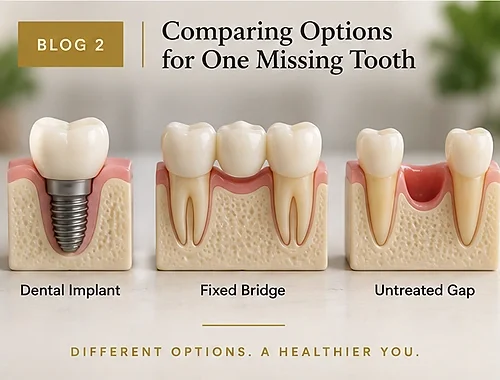
If you are missing one permanent tooth—or you know a tooth will soon need to be removed—the next question is often what should replace it. For many adults, the discussion comes down to three possibilities: a dental implant, a fixed bridge, or in selected situations, leaving the space untreated.
There is no single answer that fits every mouth. The condition of neighboring teeth, available bone, general and oral health, the location of the gap, treatment time, maintenance and cost can all affect the decision.
A Quick Way to Compare the Options
| Consideration | Dental Implant | Fixed Bridge | Leave the Space |
|---|---|---|---|
| Support | Supported by an implant placed in the jawbone | Usually supported by neighboring teeth | No replacement is placed |
| Neighboring Teeth | Usually does not require preparing healthy adjacent teeth just to support the replacement | Conventional bridges generally require neighboring teeth to support the restoration | Nearby teeth may change position over time in some situations |
| Surgery | Requires implant surgery | Does not require implant surgery | No replacement procedure, although the original extraction site still needs care |
| Bone | Bone volume and anatomy can affect candidacy and planning | Does not replace the missing tooth root | Bone changes can occur after a tooth is lost |
| Maintenance | Requires home hygiene and professional follow-up | Requires cleaning around supporting teeth and beneath the bridge | Still requires monitoring of the surrounding teeth and bite |
This comparison is general education. The condition of your mouth can change which factors matter most.
What Happens If You Leave the Space?
Not every gap creates the same problem. However, leaving a missing tooth unreplaced can affect more than appearance.
The American Dental Association notes that a missing tooth may affect chewing or speech, nearby teeth may shift, and bone loss can occur around a missing-tooth area in some cases.
Whether those concerns matter in your situation depends on where the tooth was, how your teeth meet and the health of the surrounding teeth. “Do nothing” should therefore be a conscious clinical decision rather than an assumption that the gap cannot matter.
Missing-teeth information: American Dental Association MouthHealthy
Option 1
A Single Dental Implant
A dental implant replaces the missing tooth without using neighboring natural teeth as supports. The implant is placed in the jawbone and acts as an artificial root. After it integrates with the bone, it can support a crown that replaces the visible tooth.
Why People Consider It
A conventional single-tooth implant usually does not require preparing healthy adjacent teeth merely to support the replacement. The implant also replaces the lost root at the site.
What the Process Can Involve
Implant treatment involves surgery and healing. Some patients may also need socket preservation, bone grafting or other site preparation before or during the implant pathway.
Medical conditions, smoking, bone availability and other factors can affect whether an implant is appropriate.
Dr. Singh’s common delayed pathway
- Tooth extraction when needed
- Socket preservation when appropriate
- Approximately three to four months of healing
- Reevaluation
- Implant placement when appropriate
Immediate implant placement is possible in selected cases, but it cannot be promised for every extraction.
Dental implant information: American Dental Association MouthHealthy
Option 2
A Fixed Dental Bridge
A conventional fixed bridge replaces the missing tooth by connecting an artificial tooth to restorations supported by teeth next to the gap. Unlike an implant, the replacement does not have its own artificial root in the jaw.
A bridge avoids implant surgery and may sometimes fit a treatment plan well, particularly when neighboring teeth already need significant restorative treatment. However, a conventional bridge generally depends on those teeth for support and may require them to be prepared.
Cleaning also differs because the connected replacement requires attention underneath and around the bridge. The health of the supporting teeth remains important.
Important practice-scope distinction: Dr. Singh’s practice does not provide bridges as routine general restorative dentistry. Bridges are discussed here to help patients understand a legitimate alternative—not to imply that the Yuba City office provides ordinary crown-and-bridge treatment.
Dental bridge information: American Dental Association MouthHealthy
Implant vs Bridge: What Changes the Decision?
Condition of the Neighboring Teeth
If the teeth beside the gap are healthy and intact, avoiding unnecessary preparation may be an important reason to consider an implant. If neighboring teeth already require crowns or major restorative work, the comparison may be different.
Bone and Gum Conditions
An implant needs an appropriate foundation. Bone volume, gum health and anatomy can affect whether implant placement is straightforward or whether site development is needed first.
Surgery and Treatment Time
A bridge does not require implant surgery. Implant treatment often includes a healing period while the implant integrates with the jawbone. Additional healing may be necessary when extraction or grafting is part of the plan.
Maintenance
Neither option is maintenance-free. Implants require home hygiene and professional follow-up. Bridges require cleaning around supporting teeth and beneath the replacement.
Cost
The lowest initial price is not automatically the lowest long-term cost, and a higher price does not prove that one treatment is better. Fees depend on the procedures required, insurance benefits and whether additional treatment is needed.
What If the Tooth Has Not Been Removed Yet?
This can be a useful time to discuss replacement planning.
If an implant may be considered later, the extraction site and available bone can influence future treatment. In appropriate cases, Dr. Singh may use socket preservation as part of an extraction-to-implant plan.
Not every extraction requires grafting or socket preservation, and not every patient can receive an implant immediately.
Planning before extraction can help clarify whether site preservation may be appropriate, whether healing is expected before implant placement, and what steps may follow.
Choosing the Next Step in Yuba City
An implant, a bridge and leaving a space differ in how they are supported, what they ask of neighboring teeth and bone, how long treatment may take, and how they are maintained.
Dr. Singh’s Yuba City practice provides single dental implant treatment and can manage extraction, implant placement and final implant restoration in appropriate cases. When another dentist refers a patient for implant placement only, Dr. Singh can place the implant and return the patient to the referring dentist for the restorative phase.
The goal is not to force every missing tooth into the same solution. It is to understand the condition of the site, the realistic options and the treatment sequence that fits the individual case.