
Wisdom Teeth Removal in Yuba City
Wisdom teeth do not always need to be removed. At our Yuba City practice, Dr. Harjinder Singh evaluates whether monitoring or extraction is appropriate based on symptoms, impaction, tooth position, surrounding anatomy and your situation.
When removal is recommended, the plan may include treatment of all indicated wisdom teeth in one visit, with anesthesia or sedation options selected around the case and your comfort needs.
years of extraction-focused experience
wisdom-tooth patients treated from age 14
imaging when clinically useful
Evaluation first. Treatment only when indicated.
Do Your Wisdom Teeth Actually Need to Come Out?
No—not every wisdom tooth automatically needs removal. The right decision depends on what the teeth are doing now, their position, whether disease or damage is present, how easily they can be kept clean and what the examination and imaging show.
When the tooth is creating a real problem
Extraction may be appropriate when a wisdom tooth is associated with recurring pain or infection, gum disease around the tooth, decay that cannot reasonably be restored, damage or risk to a neighboring tooth, problematic impaction, or another clinical finding that makes continued retention less appropriate.
Food repeatedly becoming trapped around a partly erupted wisdom tooth can also matter, particularly when the area is difficult to keep clean.
When the tooth is healthy and maintainable
If a wisdom tooth is healthy, appropriately positioned, functional, cleanable and not creating disease or a significant clinical concern, monitoring may be an option.
Monitoring does not mean forgetting about the tooth. It means continuing appropriate dental examinations and imaging so changes can be identified over time.
The purpose of an evaluation is to decide which wisdom teeth, if any, should be treated—not simply to find a reason to remove them.
What Does “Impacted Wisdom Tooth” Mean?
An impacted wisdom tooth has not erupted normally into a usable position. It may remain completely beneath the gum or bone, emerge only partly through the gum, grow at an angle, or press toward another tooth because there is not enough room for it to erupt normally.
An impacted tooth does not automatically mean surgery is required. What matters is the complete picture: whether the tooth is causing or contributing to disease, whether it can be monitored safely, how it relates to neighboring teeth and other anatomy, and what treatment would involve if removal is recommended.
Some impacted wisdom teeth cause obvious pain or swelling. Others are discovered during an examination or X-ray before the patient notices a problem.
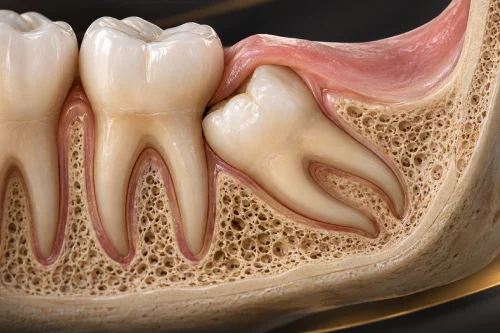
A clinical image can help patients understand tooth position without turning the page into a technical anatomy lesson.
Wisdom-Tooth Care Is a Major Part of This Practice
Wisdom teeth are not an occasional procedure at Dr. Singh’s office. They are one of the practice’s principal treatment areas.
years focused heavily on extractions and implant-related procedures
individual wisdom teeth removed in the U.S., based on the current client-provided practice estimate
for wisdom teeth and extraction cases, including patients needing additional procedural or anesthetic planning
The approximate 50,000 figure refers to individual teeth—not 50,000 patients—and is a practice estimate rather than an audited procedural count.
How the Wisdom-Tooth Evaluation Is Approached
A short practice video can sit here to explain how Dr. Singh decides whether a wisdom tooth should be monitored, removed, or evaluated with additional imaging.
What if a Lower Wisdom Tooth Is Close to a Nerve?
This is an important question, but being told that a wisdom tooth is “close to the nerve” does not by itself tell you what treatment should be performed.
The roots of lower wisdom teeth can lie near important structures within the lower jaw. The relationship varies from patient to patient, which is why appropriate imaging and individual treatment planning matter.
Dr. Singh first considers the available clinical findings and imaging. If there is a meaningful anatomical question that needs more detailed assessment, additional 3D imaging may be considered.
The goal is not to create fear around the nerve. It is to understand the anatomy well enough to make an informed treatment decision.
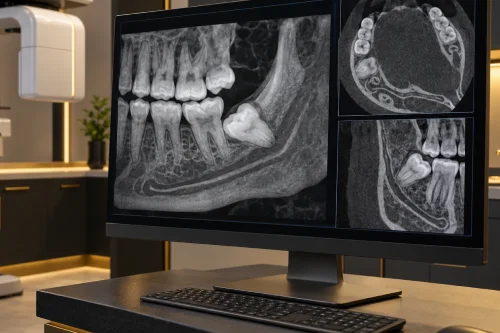
3D imaging is used selectively, not automatically.
When Does Dr. Singh Use a 3D X-Ray or CBCT?
A 3D scan is not automatically required for every wisdom-tooth patient.
Dr. Singh uses CBCT selectively when the additional three-dimensional information may help answer an important clinical question—for example, when conventional imaging suggests that a lower wisdom tooth may have a significant relationship with a nearby nerve.
The evaluation may begin with appropriate conventional dental imaging. If that provides the information needed for diagnosis and planning, a CBCT may not be necessary.
Recent outside X-rays or scans can be reviewed when they are current and diagnostically adequate, although new imaging may still be needed if the available records do not provide enough information.
Can All Four Wisdom Teeth Be Removed Together?
They can be in appropriate cases—but “all four” should not become an automatic treatment plan.
Not everyone has four wisdom teeth, and not every wisdom tooth present necessarily needs extraction. When several wisdom teeth are clinically indicated for removal and the patient and case are suitable, Dr. Singh generally prefers to treat the indicated wisdom teeth during the same appointment rather than unnecessarily dividing treatment across multiple procedures.
The final plan can still be affected by anatomy, medical history, the number and position of the teeth, anesthesia or sedation needs, insurance authorization and other individual considerations.
The important wording is all indicated wisdom teeth, not simply “remove all four.”
Anesthesia and Sedation for Wisdom Teeth
Wisdom-tooth treatment can be planned with different levels of anxiety and anesthesia support depending on the patient and procedure. The appropriate option is selected individually rather than assuming everyone needs IV sedation.
Local Anesthesia
Local anesthesia is routinely used to numb the treatment area unless there is a reason to modify the approach. Tell the office before treatment if you have previously been difficult to numb.
Nitrous Oxide
Nitrous oxide is available and may be considered for an apprehensive or anxious patient when appropriate.
Oral Sedation
Oral sedation is another option for selected patients. Medical history, medication instructions, preparation requirements and escort needs are considered as part of planning.
IV / Moderate Conscious Sedation
Moderate conscious sedation, commonly recognized by patients as IV sedation or IV conscious sedation, is available for appropriate patients. Suitability is determined individually.
If You Have Been Hard to Numb Before
Tell the office before treatment if previous dental work was difficult to numb, if an extraction was uncomfortable despite local anesthetic, or if another dentist specifically referred you because anesthesia was challenging.
Dr. Singh has identified difficult-to-anesthetize patients as a genuine referral group within the practice. Your previous experience is useful information because it can affect how the appointment is planned.
PRF for Lower Wisdom Teeth at Dr. Singh’s Practice
PRF—platelet-rich fibrin—is an important practice-specific part of lower wisdom-tooth treatment at this office.
PRF is prepared from a small sample of the patient’s own blood. Processing concentrates platelets and creates a fibrin material that can be placed in the extraction site as part of the surgical procedure.
Dr. Singh’s Current Lower-Wisdom Policy
Dr. Singh currently uses PRF for all lower wisdom-tooth extractions performed at the practice.
This policy applies specifically to lower wisdom teeth. It should not be interpreted to mean that PRF is automatically required for every upper wisdom tooth or every other type of tooth extraction.
Why Is PRF Used?
Dr. Singh uses PRF with the intention of supporting postoperative healing and reducing problems such as pain and dry socket. Current research suggests potential benefits for some early postoperative outcomes, but those findings should not be turned into guaranteed results for an individual patient.
PRF should therefore never be described as guaranteeing faster healing, preventing dry socket, eliminating swelling or ensuring a painless recovery.
The practice currently reports that PRF is not covered by insurance at the office and is paid out of pocket. The office can explain the current charge and financial arrangements before treatment.
What Happens Before Wisdom Teeth Removal?
A useful consultation should answer more than “When can the teeth come out?”
Understand Why You Are There
You may have been referred by a dentist or orthodontist, developed pain or swelling, discovered impacted teeth on an X-ray, or simply been advised that your wisdom teeth should be evaluated. Bring that context with you.
Review Health and Medications
Your medical history, medications, allergies and relevant health conditions can affect treatment and sedation planning. Do not stop prescribed medication unless the appropriate healthcare professional has instructed you to do so.
Examine the Teeth and Review Imaging
Dr. Singh evaluates the wisdom teeth and available imaging to understand their position and surrounding anatomy. Recent outside imaging may sometimes be useful.
Discuss Removal Versus Monitoring
The discussion should include why treatment is or is not being recommended, reasonable alternatives, relevant risks and benefits, and whether every wisdom tooth being evaluated actually needs treatment.
Plan Anesthesia or Sedation
If anxiety, previous difficulty getting numb or the nature of the procedure makes additional sedation worth considering, the appropriate option can be discussed before treatment.
Clarify Insurance and Financial Details
For insured patients, the process may include benefit review and preauthorization before treatment. Any known out-of-pocket items should also be explained before treatment.
What Happens During Wisdom Teeth Removal?
The exact procedure depends on how each tooth is positioned. The area is anesthetized, and any planned sedation is provided according to the treatment plan.
A fully erupted tooth may require a different approach from a tooth that is partly or completely beneath gum or bone. Depending on position, access may need to be created around the tooth and the tooth may sometimes be divided into sections so it can be removed appropriately.
For lower wisdom teeth treated at Dr. Singh’s practice, the current PRF policy is incorporated into treatment.
Recovery After Wisdom Teeth Removal
Recovery differs according to the number of teeth removed, their position, the procedure required and the individual patient. Some soreness and swelling after wisdom-tooth surgery are expected.
The practice normally performs a postoperative follow-up approximately one week after surgical treatment. Patients with a healing concern can contact the office or return for evaluation.
Recent surgical patients can normally reach Dr. Singh through the office’s forwarded after-hours phone system when necessary. This postoperative access should not be confused with the practice being a general 24-hour emergency dental clinic.
Post-Op Instructions Fit Naturally Here
A practice recovery video can reinforce written instructions about eating, swelling, socket care, activity and when to contact the office without overloading the main service explanation.
Wisdom Teeth Removal for Teenagers
Dr. Singh’s practice treats wisdom-tooth patients age 14 and older.
Age 14+ does not mean turning 14 is a reason to have wisdom teeth removed. Age establishes that the practice can evaluate and treat patients in this group. The actual decision still depends on the development and position of the teeth, symptoms, disease risk, imaging, anatomy and the individual treatment situation.
Useful questions for parents
- Why has an evaluation been recommended?
- Are the wisdom teeth causing a problem now?
- Are they impacted or still developing?
- Does each tooth actually need treatment?
- Would monitoring be reasonable?
- Should indicated teeth be treated together?
- What anesthesia or sedation is appropriate?
- What should we plan around school and activities?
Medi-Cal / Denti-Cal and Wisdom Teeth
The practice accepts Medi-Cal/Denti-Cal and provides covered extraction care, including wisdom-tooth treatment where the patient, procedure and current program requirements qualify.
Coverage should not be assumed simply because a service is clinically recommended. Current benefits, authorization requirements and documentation rules can affect the pathway from consultation to treatment.
For an insured wisdom-tooth patient, the normal process may involve consultation, imaging, discussion of treatment, insurance review and submission for preauthorization where required before the extraction appointment is scheduled.
The practice currently reports PRF as an out-of-pocket item. Dr. Singh also reports that 3D/CBCT imaging is generally treated as an out-of-pocket service at the practice.
Because insurance rules and benefits can change, the office should confirm the current situation for your case.
When Wisdom-Tooth Pain Becomes Urgent
When Symptoms Escalate
A painful wisdom tooth does not automatically mean it can or should be extracted immediately, but significant pain, swelling or signs of infection should not simply be ignored.
- Severe or escalating wisdom-tooth pain
- Noticeable dental or facial swelling
- Concern about infection or an abscess
- A tooth suddenly becoming difficult to bite or chew around
- An urgent problem with a tooth already recommended for removal
Emergency warning: Severe swelling affecting the airway, difficulty breathing or swallowing, or another serious medical emergency requires emergency medical assessment rather than waiting for a routine dental visit.
Helpful Next-Step Guides
This page answers the main wisdom-teeth decision without turning every specialist question into another long section.
For parent planning, school, sports, transport and age-related questions.
Wisdom Teeth Questions
Short answers for the practical questions people often have before requesting an evaluation.
Not necessarily. The practice receives professional referrals, but patients can also contact the office directly. If another dentist or orthodontist referred you, provide their information and bring or arrange transfer of any useful recent records or imaging.
Yes. Recent, diagnostically adequate outside X-rays or 3D scans may be considered. New imaging may still be recommended when the existing images are outdated, incomplete or do not adequately answer the clinical question involved in treatment planning.
Sometimes, but it should not be assumed. Imaging, medical considerations, sedation preparation, available time and insurance preauthorization can all affect whether treatment can occur immediately or needs to be scheduled for another appointment.
Tell the office before treatment. Dr. Singh receives some referrals involving patients who have previously been difficult to anesthetize. Your earlier experience can be considered when planning local anesthesia and whether additional sedation should be discussed.
There is no blanket practice policy requiring PRF for every upper wisdom tooth. Dr. Singh’s current confirmed policy applies to lower wisdom teeth. Other uses are determined according to the individual situation.
That depends on the anesthesia or sedation being used. Certain sedation plans require a responsible adult driver or escort and specific preparation instructions. Follow the instructions provided for your appointment.
There is no single accurate fee that can be quoted for every case from the page alone. The number and position of the teeth, imaging, treatment complexity, sedation, insurance benefits and required adjuncts such as lower-wisdom PRF can affect the financial plan.
No. The practice treats wisdom-tooth patients from age 14, but age alone does not determine whether extraction is necessary. The recommendation should come from the individual clinical and imaging findings and the risks and benefits of removal versus continued monitoring.
Request a Wisdom-Tooth Evaluation
You do not need to decide from an X-ray, symptoms or an internet search that every wisdom tooth has to come out.
Request an evaluation if you have painful or impacted wisdom teeth, were advised to have them checked, are concerned about a lower tooth near a nerve, or are planning treatment for a teenager. Share your main concern, referral status, insurance information and any previous imaging so the office can help clarify the appropriate next step.
No promises of same-day treatment, eligibility, insurance approval or a specific result are implied.
Posted on Google
 Lisa Hobdy-Horvath
Trustindex verifies that the original source of the review is Google.
My nephew had severely impacted wisdom teeth at age 31 and had an infection as well. He also has a blood condition that makes him faint easily and was understandably very anxious (has anxiety anyway) about having all 4 teeth removed- without anesthesia. Dr. Singh and his assistant had the BEST bedside manners. After the initial visit, Dr. Singh laid out the procedure, all the while making my nephew feel at ease, and scheduled us back in about 10 days. Dr. Singh let me stay in the extraction room to help comfort my nephew, numbed him up and kept checking in with my nephew on his comfort level. The wisdom teeth were huge and stuck and the Dr got them out! The after care instructions and medicine were very helpful and thorough and my nephew felt noticably better after a week, & was eating soft cooked foods by week 2. The office is inviting and very clean. Staff is friendly as well and we HIGHLY recommend this business!Posted on Google Jordin TaylorI had a good experience getting my wisdom tooth extracted. The staff was friendly, helpful, and made me feel comfortable throughout the appointment. The dentist explained what was going to happen before starting and answered my questions. The procedure was quicker and easier than I expected, and they also gave me clear instructions for taking care of my mouth afterward. Overall, I would recommend this office to anyone who needs to get a wisdom tooth removed.Posted on Google
 Jamie HowellFriendly and fast!Posted on Google
 Esmeralda Martinezgreat work
Owner's reply
Thanks for the review.Posted on Google Tanisha JohnsonBeautiful clean office, very kind staff, they made the whole process of extraction smooth and easy.Posted on Google
 Li XiongGoooooooooooooopood
Owner's reply
ThanksPosted on Google Miguel MadrigalDr. Singh did an amazing JOB extracting all of my teeth👍🏻I GIVE him a 5 Star🥰ThanX Dr. Singh
Owner's reply
Thank you very much.Posted on Google Hader AliDr. Harjinder is an excellent doctor; whenever I have taken my mom and dad to see him, he has done a great job.
Owner's reply
Thanks for the feedback.Posted on Google Derrick Taylor
Owner's reply
ThanksPosted on Google Michelle VilchezAmazing work! I really enjoyed this place to get me wisdom tooth extraction because other places I took a look at said after surgery where my extraction was would be just a dry socket and over here at Harjinder they take blood from you and insert it after extraction so your not left with a dry socket and heal a-lot faster. It gave me a way better healing process than other people I know that have gone other places! I felt NO pain throughout my procedure!Load moreVerified by TrustindexTrustindex verified badge is the Universal Symbol of Trust. Only the greatest companies can get the verified badge who has a review score above 4.5, based on customer reviews over the past 12 months. Read more